
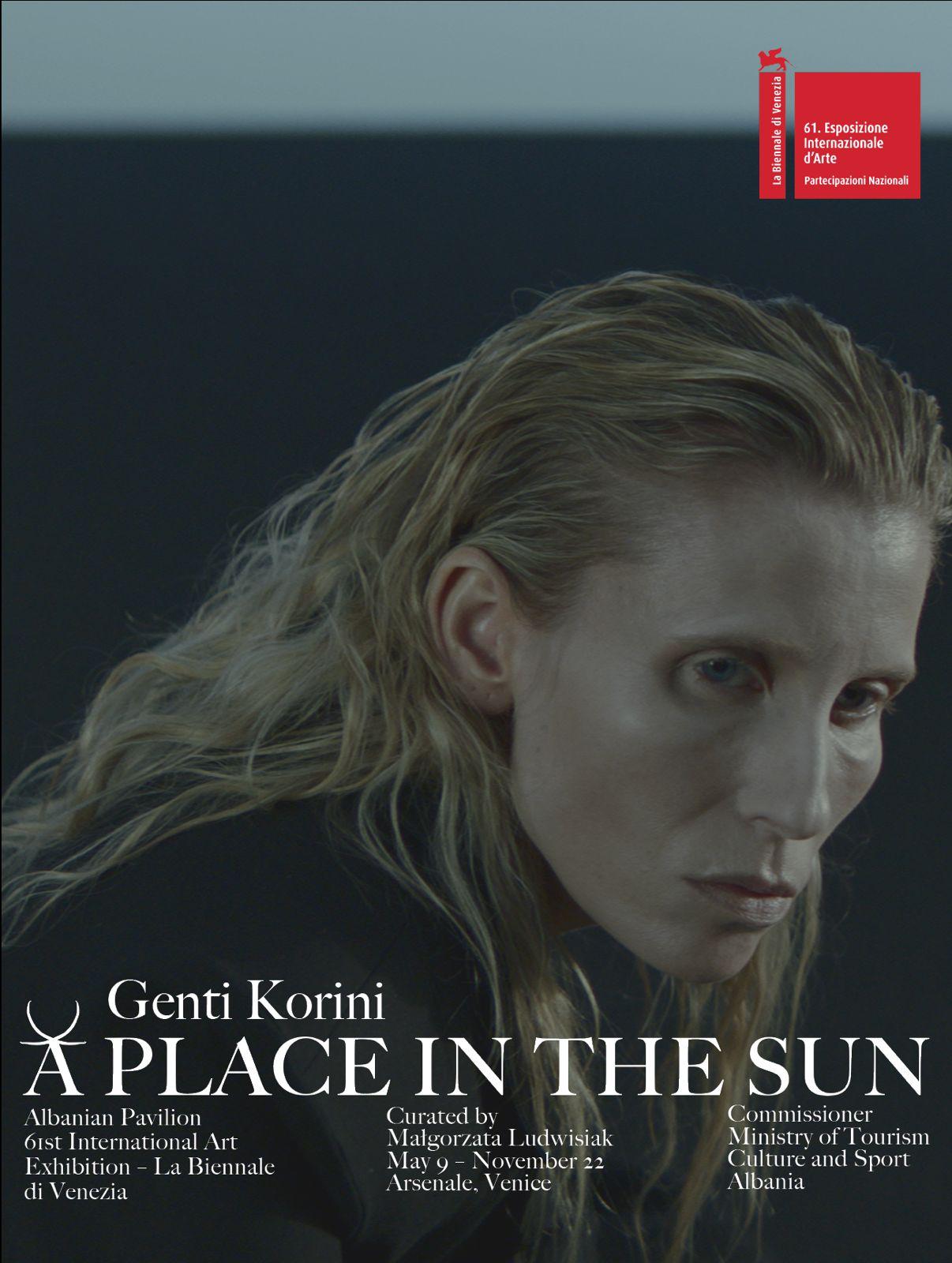
Within the three-channel video work, live acting, puppetry, animation and an original sonic score converge to form a fictional theater staged in Zaum—a transrational experimental language developed by Russian Futurist poets in the early 20th century. Zaum was created as a “pure language” without any grammar and syntax rules, meant to decompose the social order. The artist uses the irrationality of Zaum to take the viewer to the limits of language, and beyond the possibility of communication, to allow them to create a space where anything can be said anew.
On the one hand, the exhibition diagnoses Albania as a “somewhere place,” invariably defined by external and internal projections about it. On the other hand, it becomes a poetic expression of all invisible cultures, minor languages, and the unknown. The main point of reference for the artist is a Bloodless Murder magazine and its “Albanian Issue” (1916), published by an avant-garde group based in Petrograd (today Saint Petersburg). This magazine satirized the nationalistic and imperial pretensions of pre-revolutionary Russia, portraying Albania through a prism of exoticism and orientalist fantasy. Within the colonial gaze presented in Albanian Issue, Albania emerges simultaneously as a romanticized frontier and as a stage for civilizational hierarchies, revealing more about the anxieties and ambitions of its foreign observers than about the country itself.
Genti Korini’s paintings, videos, objects and photographs, as well as his latest film, Spider’s Envy, presented at Manifesta 14 (2022), revolve around the history of Albania and its relationship to modernity, its past and present-day heritage, and the tensions between reality and fiction, less as fixed narratives than as unstable conditions. This project is a continuation of Genti Korini's longstanding interests in cultural identities and their complex manifestations. Korini links the disquiet of the present and projections about the unknown to the unsettled dreams of a century ago, when borders, languages, and identities were in flux. A Place in the Sun becomes a speculative stage where history, fantasy, and ideological imagination overlap.
The Albanian Pavilion is commissioned by the Ministry of Tourism, Culture and Sport, Albania.
Genti Korini’s work investigates the interplay between aesthetics and ideology, perception and projection, past and present, fiction and historical reality, abstraction and representation. Drawing from the cultural and historical frameworks of his native Albania, his practice examines how ideology manifest through images and form engaging directly with the politics of aesthetics across the legacies of modernity, modernism, post-communism, and the neoliberal present. His work is research-driven and draws from a diverse range of influences, including art history, architecture, literature, and film.
The viewer, devoid of the immediate context of the works, is invited to explore the migration and reconfiguration of decontextualized forms, images and narratives, as symptoms of social and ideological transformations. Shifting fluidly between painting, sculpture, photography, and video, Korini invites viewers to look beyond the surface, and engage with deeper political, social, and conceptual implications of the work. His imagery often explores the migration and transformation of images and symbols, treating them as markers of broader cultural and ideological change
Represented by Jecza Gallery, Korini has collaborated closely with the gallery through several solo exhibitions at the gallery and international presentations placing his works within many important international collections.
Learn more about the artist here
