Art Ono, Seoul: Marius Bercea, Genti Korini, Tincuta Marin, Iosif Kiraly, Radu Oreian, Laurian Popa, Paul Robas
Past event
Overview
On the occasion of its first art fair participation in Asia, at Art OnO Seoul, Jecza Gallery presents a focused selection of artists: Marius Bercea, Iosif Király, Tincuța Marin, Genti Korini, Laurian Popa, Radu Oreian, and Paul Robas. The presentation offers a balanced dialogue between established and emerging practices across painting, photography and sculpture, with an emphasis on continuity, material presence, and craftsmanship.
Marius Bercea is widely recognized as one of the leading figures of the Cluj School of Painting - a loosely affiliated group of artists who emerged in Cluj-Napoca after the 1989 Romanian Revolution. Known for his vividly layered, psychologically charged works, Bercea blends personal memory, cultural history, and imagined geographies into a visual language that is both intimate and expansive. Over the past two decades, Bercea’s paintings have explored the social and emotional landscapes shaped by consumerism, capitalism, and migration. His richly textured compositions oscillate between realism and fiction, glamour and decay, utopia and collapse. At the core of his practice lies a fascination with the thresholds—where past and present, East and West, private and collective experience intersect.
Iosif Kiraly stands as one of Romania's most celebrated artists in the realm of photography, creating a legacy that intertwines perception, time, synchronicity, and memory. His diverse body of work spans photography, installation art, drawing, and recently, video, each medium meticulously crafted to explore the intricacies of human experience and societal transformation.
Király's artistic journey began in the 1980s when he became an active participant in the mail art network, an international underground movement tied to Fluxus. This experience deeply influenced his approach to art, fostering a collaborative and interdisciplinary ethos. Post-1989, Király emerged as a prominent figure in the Romanian art scene, both as an individual artist and as a member of the subREAL group, known for its provocative and thought-provoking works.
Recently, works by the artist have entered the collection of the Museum of Modern Art (MoMA), New York, further consolidating his international recognition.
Genti Korini is an Albania-based artist who works at the intersection of fiction and historical reality, past and present, perception and projection, abstraction and representation. Drawing from the cultural and historical frameworks of his native country Albania, his practice examines the afterlives of modernity, modernism, post-communism, and the neoliberal present – less as fixed narratives than as unstable conditions. His work is research-driven and draws from a diverse range of influences, including art history, architecture, literature, and film. Working across painting, moving image, photography, and objects, Korini invites viewers to look beyond the surface and engage with deeper political, social, and conceptual implications of the work. His imagery often explores the migration and transformation of decontextualized forms and symbols, treating them as markers of broader cultural and ideological change
In 2026, he represents the Albanian Pavilion at the Venice Biennale, further affirming the international recognition of his practice.
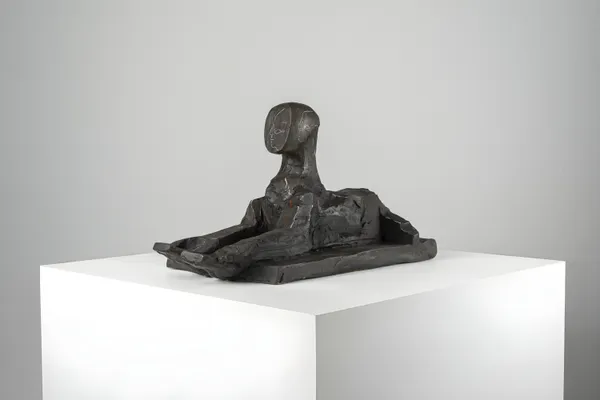
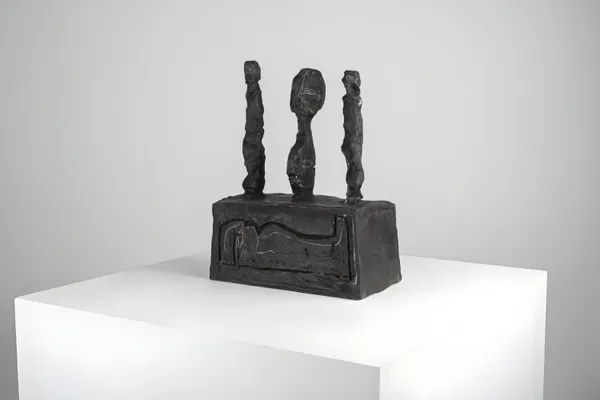
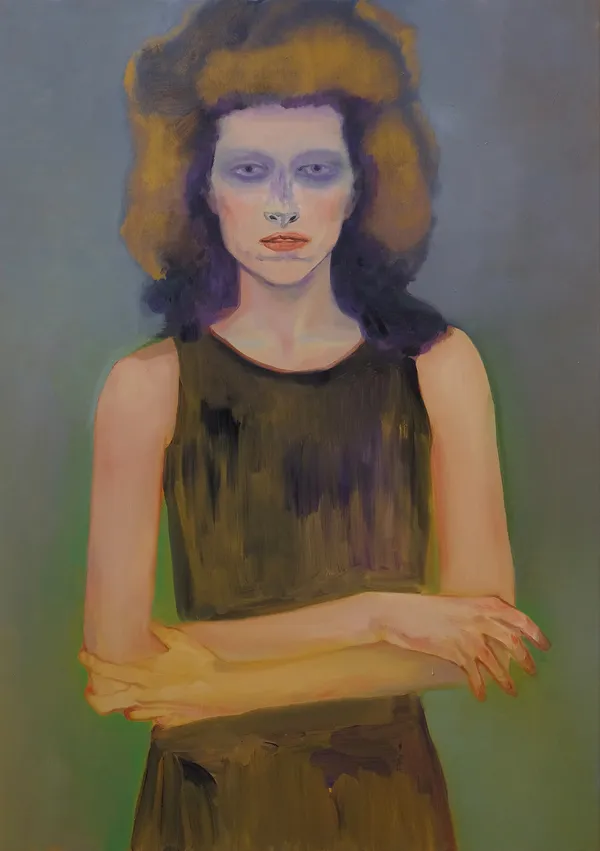
Tincuta Marin was born 1995 in Galati and graduated from The University of Art and Design, Cluj, Romania, in 2019. Her recent solo exhibitions include Gloaming at Galeria Plan B in Berlin; Where the Sun Sleeps at Oratorio dei Crociferi in Venice; Purring Figure at Ellen de Bruijne Projects, Amsterdam and Distant Realities at Jecza Gallery in Timisoara. Tincuta Marin’s new body of work shows ancient symbolism and modernist fragmentation to converge into a dark, contemplative space. Inspired by Egyptian mythology, creation narratives, and protective rituals, as well as Romanian folk belief and its archaic gods and household spirits, Marin reactivates “magical thinking” as a contemporary strategy. Her work positions mythic, often female figures as resilient, protective presences in a world marked by change and uncertainty. This dark palette registers contemporary unease and fragility, turning the booth into a threshold between sanctuary and exposure, between the ancient sacred and the fragile present.
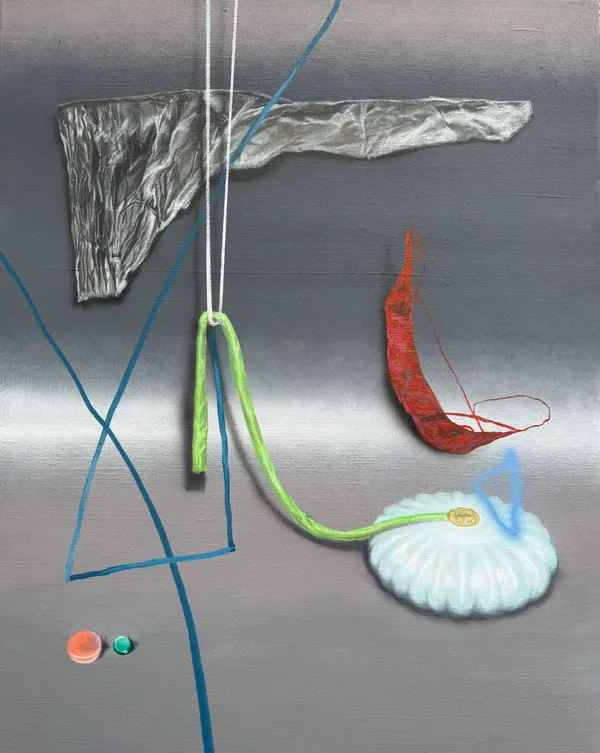
Laurian Popa is a Romanian artist, whose practice explores the boundaries between drawing, object-making, and spatial composition, often engaging with found materials and fragments of everyday life. The combination of compositions, drawings and objects created by Laurian Popa forms the image of a material figurative, bold but not familiar. A figurative that rather translates into reality an object with an unusual identity, a processing of remnants of objects gathered and recomposed into another dimension. With an obsolete identity, broken from the usual context, the image of the objects becomes an exercise of decryption, assimilation, recontextualization: a signal of the decadence of an “arranged” but real space.
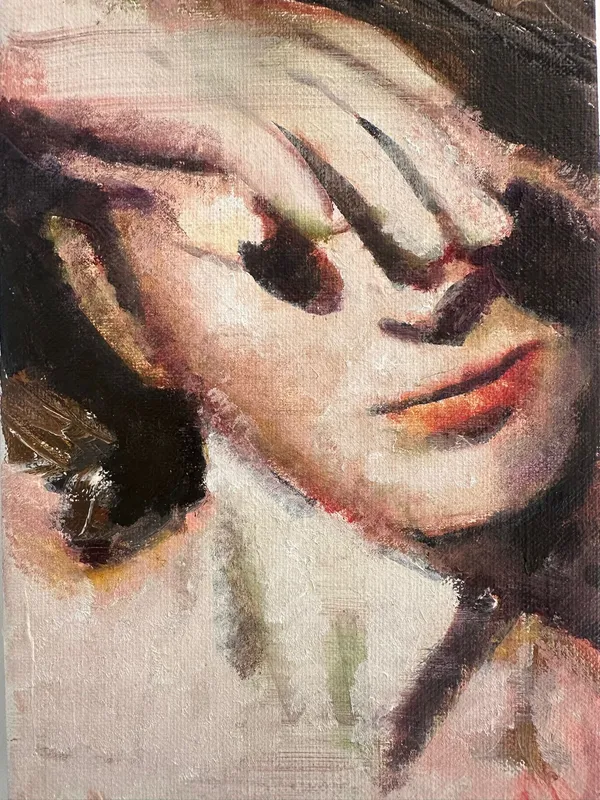
Radu Oreian is a Romanian artist who is currently living and workign in France. His practice has at its core the classical mediums of drawing and painting and explores the way history, ancient myths and archives shape our society and our understanding of humanity. His ‘Molecular Painting’ are a miniature-like format of works that pulsate with details and thus intend to draw the viewer's eye deeper and deeper into the fabric of the paint and hopefully deeper and deeper into the nature and meaning of painting. The red thread that runs through Radu Oreian’s works is creating a new, meditative visual imprint of a peculiar density that appears to exist in a pulsing state of tension and relaxation.
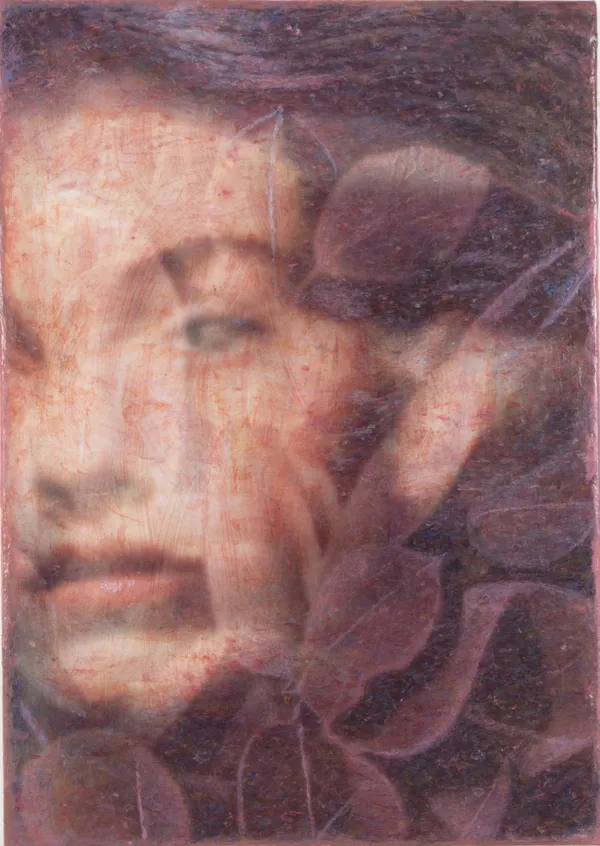
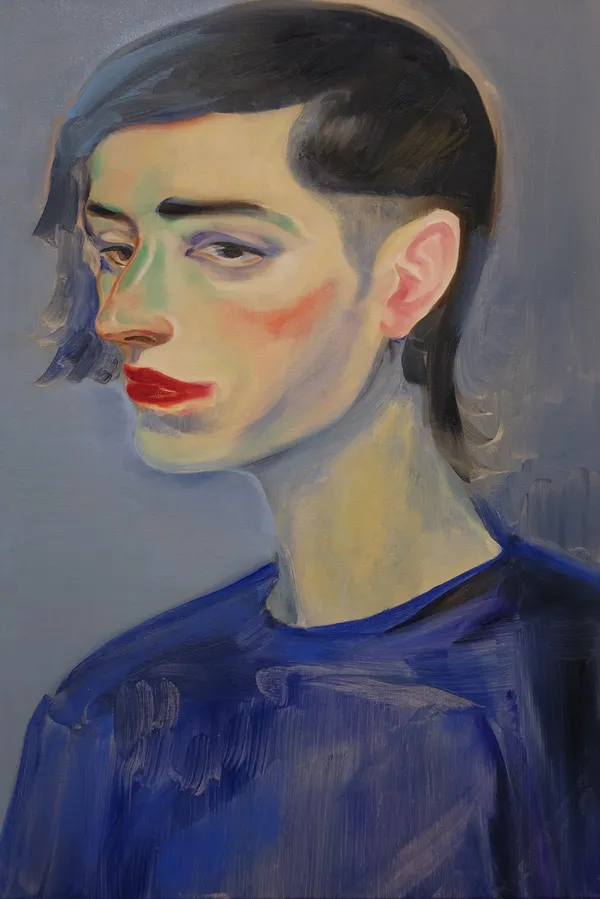
Paul Robas is a Vienna-based Romanian artist whose evocative and multi-layered portraits delve into the ephemeral nature of memory and the human experience. Through experimentation and a particular attention posed on the surface of the canvas, Paul’ practice explores the tension between the real and the imagined, crafting works that blur the boundaries between these states.
Central to his approach is a fascination with the reproduced image. Paul begins with digitally manipulated and found photographs of unknown individuals, transforming them through a meticulous process of manual and automated techniques.
Works
-
 Marius Bercea, Untitled (Boy Watching Breaking News), 2023
 -
Marius Bercea, Emoji Games, 2026
-
Tincuta Marin, Untitled, 2026
-
Tincuta Marin, Untitled, 2026
-
Paul Robas, The One After the Other, 2024
-
Paul Robas, Peel, 2024
-
Laurian Popa, The inventory of emptiness, 2025
-
Laurian Popa, Porcelan, buttons and cloth, 2026
-
Genti Korini, Faux Fur, Gentle Skin, 2024
-
Genti Korini, Illusions, 2024
-
Radu Oreian, Untitled, 2023
-
Radu Oreian, Untitled, 2025





Installation Views


